Types of Lift
Thermals
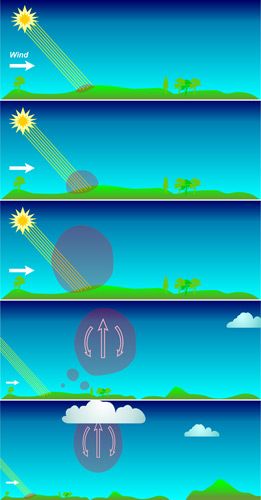
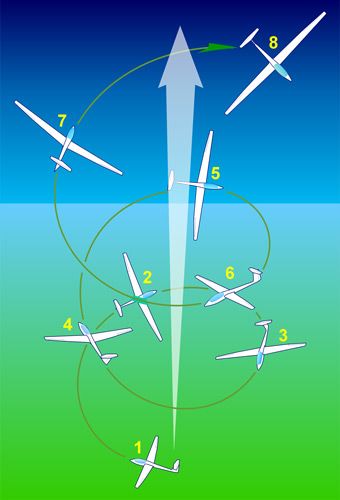
On a summer’s day, you can see birds circle upwards without flapping their wings. They are ‘thermalling’. A thermal is a volume of air that has been heated by the sun more than the surrounding air – imagine if you were standing on sunlit concrete, you would feel warm! As you know, hot air rises and it is circling within this air that allows birds and gliders to go upwards. Next you may ask “so how do you know where the thermals are?” Well, sometimes this is educated guess work, based on how you imagine ground features below are warming up. However, often cumulus (cotton-wool type) clouds form at the top of the thermal, marking where the thermals are.
Occasionally, you may be joined in the thermal by a bird – from a Swift to an Eagle. You can never do it as well as they can, but it’s great fun trying! Thermals are used in cross-country flying – you climb in a thermal to gain the height to move forwards to the next thermal on track (or thereabouts). The largest flight in the UK was done like this. Just over 1000 kilometers were covered in the flight which took about 12 hours.
Ridge Lift
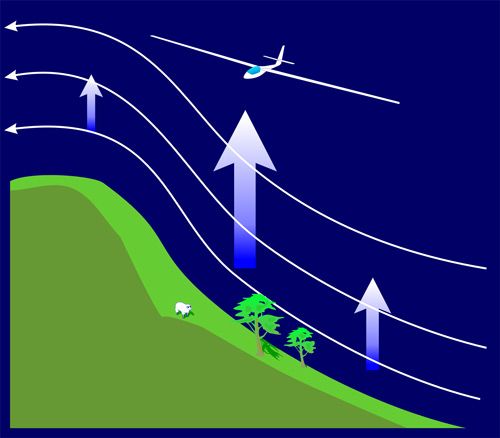
Another way of staying airborne requires a hill (ridge), and the wind to blow against the face of it. Try to imagine this scenario: When the wind hits the hill, it gets forced upwards.
Again, it is this upward movement of air that allows gliders to stay airborne. With a long ridge, it’s possible to travel considerable distances without turning, generally flying fast and low to stay in the best ‘lift’ close to the ridge.
Wave Lift
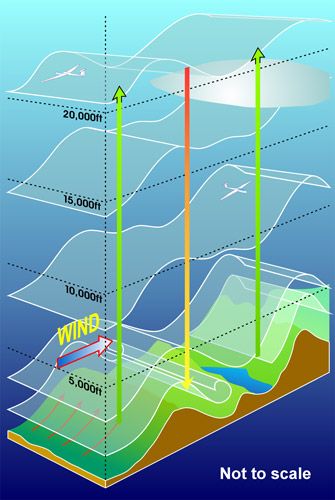
Similar to ridge lift is a phenomenon called ‘wave lift’. This is a little harder to imagine.
It arises from the wind blowing against a hill, but this time the air comes back down (on the far side of the hill) and “bounces” off the ground and goes back up again, creating a very smooth upwards flow of air. Often, this form of lift is capped by a cigar shaped ‘lenticular’ cloud.
This wave may go back down and up again for several cycles, meaning that you don’t actually have to be close to any hills to use it!
The furthest flights in gliders have been done using this lift – the best being 2463 kilometres (1530 miles) which was done along the Andes, all in one flight and one day!
Wave lift is also known to go very high – the world height record in a glider is just a little short of 50,000 feet!